
Meet Our Team
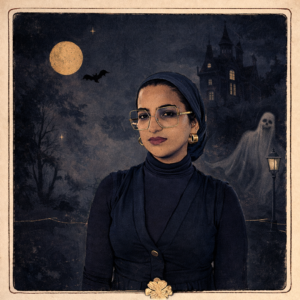
Azania Imtiaz Patel
Azania is a multi-hyphenate based in Mumbai, India. She is currently building ‘India Ghost Project’, an anthropological repository of paranormal narratives in the country. Azania’s research focuses on the politics of fear, questions of self, othering, and how stories become a tool for identity assertion. As a journalist, she has written on tech policy for The Stack, and spent the better half of the past two years in various capacities at The Economist. She is a Rhodes Scholar and holds an MSc and an MPP from the University of Oxford.
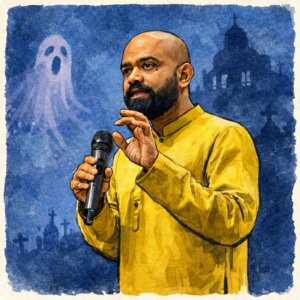
Diwakar Kishore
Diwakar Kishore is a development economist and co-lead of the India Ghost Project. He holds a PhD from the LSE’s International Inequalities Institute, an M.Ed. from Harvard, an MPP from Oxford, and a BA LLB from NLSIU. He has worked with the World Bank on education, health, and food security across Africa and Asia, and previously practiced law in both commercial and legal aid roles in India. His research explores how policy, economics, and belief intersect to shape human behaviour and the stories we tell.

Zaara Merchant
Zaara studies Economics at McGill University, exploring how economic ideas intersect with society and everyday life. She’s interested in the connections between economics and broader social dynamics. Beyond the classroom, she is actively involved in writing, editing, and debate.
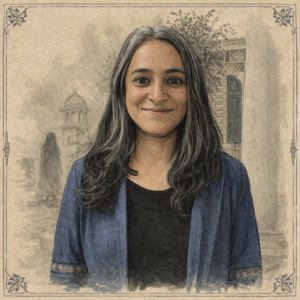
Avantika Prabhakar
Avantika is a development economist based in New Delhi, India. She holds a Ph.D. in Economics from the University of Virginia and an M.A. in Economics from Boston University. Her experience spans the fields of public service delivery, gender, labor markets, and sustainability. Her research examines how social institutions shape economic behavior and influence access to resources among low-income communities.
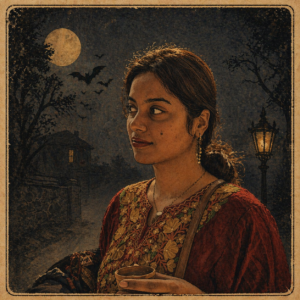
Zohra Salih
Zohra Salih is a writer and researcher based in London, working across speculative fiction, memoir, essay, and visual art. Trained in anthropology, literature, philosophy, and cognitive science, her work engages questions of ecology, aesthetics, memory, and hauntology.
Her recent research explores the relationship between sound, landscape, and presence, with a current focus on the monsoon in India and the aesthetic forms and sensibilities it generates. She completed her MA in Anthropology at the London School of Economics and her BA in Philosophy at St. Stephen’s College, University of Delhi. She was also a Young India Fellow at Ashoka University.
She is Editor-at-Large for India at Asymptote Journal, and her writing has appeared in Hakara Journal.
Madhubanti Talukdar
Madhubanti is a social science researcher based in Kolkata, with nearly five years of experience in working across academic and development sector organizations in India. She has travelled extensively, conducting fieldwork across remote and challenging geographies. She holds a BA in Sociology from Presidency University, Kolkata and a MA in Sociology from South Asian University, New Delhi, and occasionally writes for Doing Sociology, an independent, women-led academic blog.
The Project
We use a mixed-methods approach to map the paranormal in India, combining data, stories, and lived experience. Our methodology includes:
- Surveys
Online and in-person questionnaires gather data on demographics, belief systems, spending habits, and motivations for engaging with paranormal experiences. - In-depth Interviews
We speak with ghost-tour operators, temple priests, exorcists, paranormal investigators, and everyday believers to understand how people interact with the supernatural. - Field-based Ethnography
Our researchers visit haunted sites, attend rituals, and document practices to build a grounded, regional understanding of belief in practice. - Economic Analysis
We analyse data on paranormal tourism, spiritual services, and informal markets to estimate the scale and impact of India’s ghost economy. - Content and Media Analysis
By studying news stories, social media, films, and folklore, we trace how paranormal narratives circulate and influence popular understanding. - Crowdsourced Stories and Locations
Through our platform, the public can submit personal stories and geotag haunted places—building a participatory archive of India’s spectral geography.
The India Ghost Project is an independent, not-for-profit research initiative that explores the intersections of belief, economy, and modernity in contemporary India. We are actively seeking collaborators—both individual and institutional—who are excited by the possibilities of this work and want to contribute to its growth.
For Individuals
We welcome contributions from writers, researchers, artists, oral historians, and anyone with an interest in the paranormal. Whether you have a story to share, a visual project to pitch, or an idea for collaborative fieldwork or public programming—we’d love to hear from you.
For Universities and Research Centres
We are open to partnerships with academic departments and research centres working in anthropology, sociology, urban studies, media, religion, and related fields. Opportunities for collaboration include joint research, co-hosted workshops, teaching and learning partnerships, internships, and data-sharing. We are especially interested in interdisciplinary collaborations that open new ways of studying belief and urban transformation.
For Funders and Grantmakers
As a non-profit, independently run project, we are actively seeking funding to expand our fieldwork, build open-access tools, and sustain our public archive. We welcome discussions with research funders, foundations, and impact-driven grantmakers interested in questions of cultural continuity, informal economies, and alternative epistemologies in South Asia.
To collaborate, co-create, or support us, get in touch at: contactus@indiaghostproject.com